10 Tips for Buying Brass Washers
Brass Washers may look like simple hardware, but the wrong size or alloy can undermine a carefully assembled joint. This guide introduces ten practical checks for choosing washers that fit the fastener, suit the working environment, and arrive with reliable product information. Small details matter.
Start with measurements: confirm the inner diameter, outer diameter, and thickness against the bolt and available space. Then consider the brass alloy, finish, and expected exposure to moisture, heat, or chemicals. A washer used indoors may face very different conditions from one fitted near salt air or frequent cleaning. Match its material to the surrounding components, too, since contact between dissimilar metals can create concerns in some environments.
Load and assembly needs deserve equal attention. Think about clamping force, surface protection, and whether a flat, lock, or specialty washer is appropriate for the application. Check dimensional tolerances, stated specifications, packaging, and supplier documentation rather than relying on a product photo alone. Ask for a sample when fit is uncertain. It can prevent a costly mismatch.
A checklist helps, but it cannot replace application-specific engineering judgment. It is easy to focus on price and overlook thickness variation or finish quality; that happens more often than buyers expect. The tips ahead offer a grounded way to compare options, ask sharper questions, and choose Brass Washers with fewer surprises.
Define the Application and Choose an Alloy: C26000 Contains 68.5–71.5% Copper
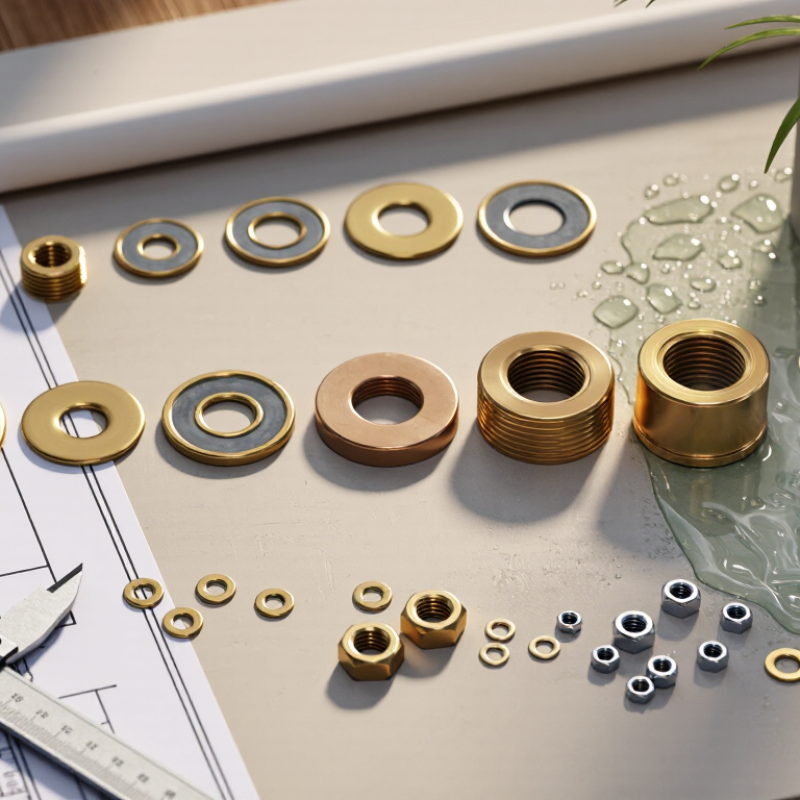
Before choosing a brass washer, define its job and working conditions. Will it spread a bolt’s load, prevent surface damage, or maintain spacing? Note the fastener size, expected pressure, vibration, moisture, and temperature. Small details matter. A washer under a lightly loaded cabinet screw faces different demands from one in a vibrating pump assembly. Measure the washer’s inner diameter, outer diameter, and thickness against the available space; a close fit can still bind during installation.
C26000 brass contains 68.5–71.5% copper, with zinc making up most of the balance. This alloy is commonly selected for its useful combination of formability and strength, especially when washers need consistent shaping. But the copper percentage alone does not make it the right choice. Check whether the part will meet water, cleaning chemicals, or dissimilar metals, since those conditions can change corrosion performance. I used to treat “brass” as a complete material specification; it isn’t. Ask for the alloy designation and, where traceability matters, a material certificate. Also confirm thickness tolerance and edge quality: a burr can scratch a mating surface or affect seating.
Match the Bore and Outside Diameter to Fastener Size and ISO 7089 Dimensions
A brass washer should fit the fastener’s shank without forcing, while its outside diameter must cover the bearing surface. Do not assume an M6 label means a 6 mm bore. ISO 7089:2000 lists a standard M6 washer with a 6.4 mm bore, 12 mm outside diameter, and 1.6 mm thickness. For M8, the listed dimensions are 8.4 mm, 16 mm, and 1.6 mm. These figures give a practical reference point, but confirm that the selected washer follows the standard’s normal series and matches your drawing. That gap matters.
Check the fastener’s actual shank and the available clearance before ordering. A bore that is too tight can bind during assembly; one that is unnecessarily large may allow poor centering. The outside diameter matters too: a narrow washer concentrates load on a small patch, while an oversized washer can foul nearby parts. Measure both. In shop-floor checks, a caliper can quickly flag a mismatch, though it cannot replace the supplier’s dimensional tolerances. Brass is relatively soft, so edges and contact surfaces deserve inspection; burrs can mark components or affect seating. I would not rely on nominal size alone. Verify the part drawing, especially when washers must fit into a recess or sit beneath a specific fastener head.
10 Tips for Buying Brass Washers - Match the Bore and Outside Diameter to Fastener Size and ISO 7089 Dimensions
| Tip |
Fastener Size |
Nominal Bore (d1) |
Outside Diameter (d2) |
Nominal Thickness (h) |
Buying Check |
| 1. Match the washer bore to the fastener. |
M3 |
3.2 mm |
7 mm |
0.5 mm |
Choose a bore that clears the screw without excessive looseness; allow for the specified washer tolerance. |
| 2. Check the outside diameter for adequate support. |
M4 |
4.3 mm |
9 mm |
0.8 mm |
Confirm the washer will cover the contact area and distribute the clamping load as intended. |
| 3. Compare the dimensions with the standard size. |
M5 |
5.3 mm |
10 mm |
1.0 mm |
Request dimensional details if a listing gives only the fastener size, not the washer dimensions. |
| 4. Check clearance around the fastener. |
M6 |
6.4 mm |
12 mm |
1.6 mm |
Allow for assembly tolerances and any coating or surface treatment on the fastener. |
| 5. Verify the washer fits the available space. |
M8 |
8.4 mm |
16 mm |
1.6 mm |
Check that the outside diameter will not interfere with nearby parts or countersinks. |
| 6. Select thickness for the assembly stack-up. |
M10 |
10.5 mm |
20 mm |
2.0 mm |
Include washer thickness when checking available thread engagement and overall assembly height. |
| 7. Confirm that the bearing area is sufficient. |
M12 |
13 mm |
24 mm |
2.5 mm |
For softer or easily marked surfaces, check whether a larger outside diameter is required. |
| 8. Check the drawing before ordering less common sizes. |
M14 |
15 mm |
28 mm |
2.5 mm |
Compare bore, outside diameter, and thickness against the assembly drawing. |
| 9. Confirm material and service suitability separately. |
M16 |
17 mm |
30 mm |
3.0 mm |
Check the brass alloy and environment requirements; dimensional conformity alone does not specify material performance. |
| 10. Verify dimensions and tolerances on the order specification. |
M20 |
21 mm |
37 mm |
3.0 mm |
State the required standard, material, and tolerances so the supplied washer can be checked on receipt. |
Dimension note: Values shown are nominal reference dimensions in millimetres for ISO 7089 plain washers, normal series, product grade A. ISO 7089 defines dimensions and tolerances, not brass alloy or performance. Confirm the applicable standard edition, tolerances, and material specification with the supplier before ordering.
Check Washer Thickness, Flatness, and Burrs Against the Required Tolerances
Measure each brass washer against the drawing, not the catalog description. ISO 4759-3 defines tolerance systems for plain washers, while ISO 7089 provides dimensional tables. For example, its M6 washer dimensions include a 6.4 mm bore, 12 mm outside diameter, and 1.6 mm nominal thickness. Treat these as reference dimensions, not automatic acceptance limits; the specified grade and purchase requirements matter. Use a micrometer for thickness, measuring several points around the washer. Thin brass can vary across a sheet. One reading may miss it.
Check flatness on a clean surface plate, then look for rocking, gaps, or a visible dish. Inspect both faces and the bore edge under good light. A burr can catch a fingernail, distort a stack, or interfere with assembly. ISO tolerance tables help set expectations, but they do not replace a part drawing or agreed inspection plan. Keep the measuring tool’s calibration and resolution in mind; a display with extra digits is not proof of accuracy. I would record the highest and lowest thickness readings, even when they pass. It feels fussy, but a borderline batch can behave differently once clamped.
Assess Corrosion Resistance and Brass-to-Fastener Compatibility
Brass resists rust, but it is not immune to corrosion. Match the washer’s alloy to the actual environment: indoor humidity, washdown, salt spray, or chemical exposure. Chlorides and ammonia can attack some brass alloys, while trapped moisture may leave green or dark deposits. Check the alloy specification and available test data rather than relying on the word “brass.” Small detail. Important.
Brass washers often pair with brass or bronze fasteners, but mixed metals deserve closer attention. Moisture can electrically connect brass and stainless steel. Depending on the electrolyte and exposed surface areas, this may accelerate corrosion of the less noble metal. Plated steel adds another variable: scratches can expose the base metal. Keep washer and fastener finishes compatible, and consider seals or insulating sleeves where wet contact is likely.
Ask whether any coating suits the washer’s bearing surface and installation torque. Inspect a sample after tightening; burrs, crushed edges, or damaged plating can create weak spots. One caveat: a quick bench check cannot predict years of service. For coastal, outdoor, or chemical-exposure assemblies, consult application-specific corrosion data. Don’t guess.
Verify Alloy Certificates, Dimensional Inspection, and Total Purchase Cost
A brass washer may look simple, but small variations can affect fit and service life. Before comparing quotes, request an alloy certificate tied to the production lot. It should state the alloy designation, relevant material standard, and lot or heat reference. A certificate without traceable lot details offers limited assurance. Keep the paperwork.
Dimensional inspection should follow the drawing, not just a catalog description. Check outside diameter, inside diameter, thickness, and flatness with suitable gauges or calipers. For a sample order, measure several pieces from different parts of the package. Look for burrs, uneven edges, and scratches that could interfere with assembly. Small details matter. Record the results and ask how the supplier handles out-of-tolerance parts.
Compare total purchase cost, not only the quoted price per washer. Include tooling charges, minimum order quantities, inspection fees, packaging, freight, and expected scrap. A low unit price can become expensive if dimensions vary or delivery is delayed. Request a written lead time and confirm whether it covers production and shipping. It is easy to focus too much on the cheapest quote; I would reconsider that habit when a rejected batch could interrupt a job. Allow for uncertainty, especially on a first order. That can sting.