What Are the Top 10 Black Screw Manufacturers in China?
Black Screws are widely used in furniture, appliances, machinery, and construction, where appearance and corrosion resistance both matter. Their performance depends on more than color; base material, thread accuracy, coating, and installation conditions all play a part. For buyers, choosing a Chinese manufacturer can mean balancing price, production capacity, customization, and dependable quality control. A dependable supplier should explain its finish options, inspection process, and ability to keep specifications consistent across repeat orders. Small details matter.
The title asks for the top ten, but rankings vary with product requirements, order size, and verification methods. This guide presents ten manufacturers as candidates for comparison, rather than treating any ranking as universal or permanent. The comparison should consider product range, material and coating information, dimensional tolerances, sample availability, and communication before purchase. Ask how black finishes are applied, how coating consistency is monitored, and whether samples match production specifications. A sample may look excellent under showroom lighting. That is not enough. Compare threads, head shape, finish coverage, and packaging against the intended application. Supplier claims deserve confirmation through samples and written technical details; sales language alone cannot establish manufacturing capability. The aim is practical screening, not an unsupported endorsement. Details matter. Readers should confirm current capabilities directly, since product lines and processes can change.
How Black Screws Are Classified by Drive Type, Thread, Steel, and Finish
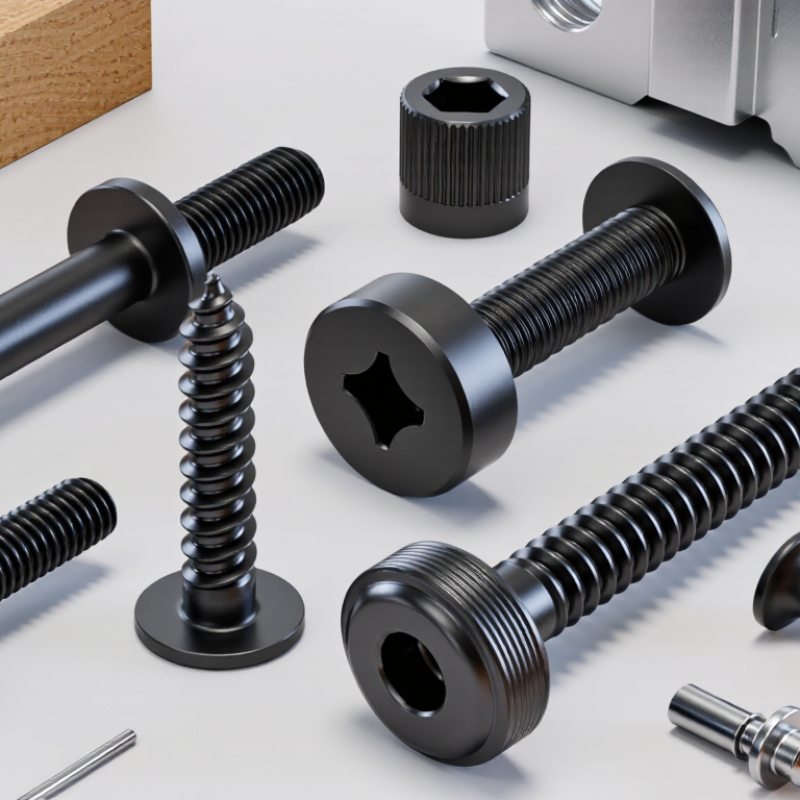
Black screws are not one uniform product. Their drive type affects how force reaches the fastener. Phillips drives are common in general assembly, while Torx-style star drives help reduce slipping under higher torque. Slotted drives remain simple, but the tool can wander if pressure is uneven. Small detail, big difference. Choose a drive that matches the bit, installation speed, and expected load. A screw that looks right may still be awkward to install.
Thread design is another key classification. Coarse threads grip wood and softer materials quickly; fine threads suit many metal assemblies and thinner sections. Steel grade influences strength and resistance to wear, but the right choice depends on the joint, not just a higher number. Black finishes can include oxide treatments, coatings, or paint, and they do not all provide equal corrosion protection. Check the product specification rather than relying on color alone. In a humid workshop, a black finish may show wear around the head after repeated tool contact. That part is easy to overlook. I would also verify dimensions and coating details before ordering, since classification labels can leave practical gaps.
Which 10 Chinese Manufacturers Stand Out by Product Range and Export Reach
A useful comparison of ten Chinese black-screw manufacturers starts with product depth, not catalogue size. Look for choices in carbon steel and stainless steel, several head and drive styles, and finishes such as black oxide or black phosphate. Check whether suppliers publish dimensions, coating details, and test records. Small gaps matter. A screw that looks black may not offer the corrosion resistance your application needs.
Export reach also needs evidence: documented destination markets, stable lead times, export packaging, and quality-management records are stronger signals than a broad sales claim. Grand View Research valued the global fastener market at about US$90.6 billion in 2023 and forecast 4.7% annual growth from 2024 to 2030. That figure covers fasteners broadly, not black screws alone, so it provides context rather than a ranking. Ten candidates can differ sharply in their ability to handle repeat orders, custom dimensions, and consistent finish batches. Ask for sample pieces and inspect thread fit, coating uniformity, and packaging labels. Fit matters. Even a well-equipped factory may not be the right exporter for every order.
China’s Fastener Export Reach: Top 10 Destinations
China’s 2023 exports under HS 7318, which covers iron or steel screws, bolts, nuts, washers, and related fasteners. Destination-level trade data is a market-reach indicator—not a ranking of individual manufacturers or black-screw exports alone.
Source: UN Comtrade API. Export values are reported in current US dollars.
How ISO 898-1 Strength Classes 4.8–12.9 Compare Screw Performance
When comparing black screws, ISO 898-1 strength classes describe mechanical performance, not appearance. A class 4.8 screw has a nominal tensile strength of 400 MPa and a yield strength near 320 MPa. Class 8.8 raises those figures to about 800 and 640 MPa. Higher classes, such as 10.9 and 12.9, can resist greater loads, but they also need suitable materials and controlled manufacturing. Small details matter.
The class number alone does not tell you how a screw will perform in a finished assembly. In practice, thread fit, screw dimensions, tightening method, and the mating material all affect joint reliability. A black surface may be produced by different finishes, so check its corrosion resistance and dimensional effect rather than assuming all black screws behave alike. For a loaded joint, verify the required class and product documentation. A torque value is not a strength rating. Even careful selection can miss a detail, so check the actual application and test where failure would be costly.
What a Typical 0.5–1.5 μm Black Oxide Layer Means for Fit and Corrosion
A typical black oxide layer measures about 0.5–1.5 μm, so it adds very little to a screw’s overall dimensions. Unlike a thick plated coating, it usually has limited effect on thread fit. The process converts the steel surface, rather than simply stacking a thick film on top. Still, that does not make dimensional checks unnecessary. For fine threads or close-fitting assemblies, confirm finished dimensions with the supplier.
That is very thin. Black oxide alone offers only modest corrosion resistance, especially in humid storage or outdoor service. Many screws receive a supplementary oil or sealant, which helps block moisture and gives the surface its darker, more even appearance. Ask what treatment is included; “black oxide” by itself does not describe the full protection system. A quick salt-spray result can be useful, but it should not replace testing that reflects the actual environment.
When comparing manufacturers, request coating-thickness controls, inspection records, and samples from the intended production process. Check thread engagement and appearance after handling, not just on a pristine sample. I would be cautious about assuming every black screw performs alike. A small variation in oil coverage, steel condition, or cleaning can change the result, and these details are easy to overlook.
How Buyers Compare M2–M24 Sizes, Quality Systems, Testing, and Lead Times
When comparing black screw manufacturers in China, size coverage is only the starting point. A supplier may list M2 through M24, yet tooling, thread accuracy, and finish consistency can vary by diameter. Request drawings, tolerance ranges, head-style options, and samples from the production line. Small details matter. With M2 screws, an uneven finish may affect driver fit. For M24 fasteners, review dimensional control and suitability for the intended load.
Compare documented quality systems, not just certificates. Check material records, inspection frequency, lot traceability, and procedures for handling defects. Ask for recent test reports linked to the quoted grade and finish. Depending on the application, checks may include dimensions, hardness, torque, coating thickness, or salt-spray exposure. Test scope matters. Confirm whether the black finish is intended for appearance, corrosion resistance, or both.
A lead-time quote should separate production, finishing, inspection, and packing. Ask about the production slot, sample approval, planned ship date, and how delays are communicated. Custom parts may need extra time for first-article approval; stock items may move faster. Still, promises are easy. Compare delivery records across several orders where available, rather than relying on one reassuring email. An incomplete answer is a reason to clarify, not automatic grounds for rejection.