Top 10 Best Stainless Steel U Bolts for Durability and Versatility?
Stainless Steel U Bolts are essential components in various industries due to their remarkable durability and versatility. According to a report by Market Research Future, the U-bolt market is expected to grow significantly in the next few years, driven by the increasing demand in automotive, construction, and marine applications. Stainless steel, known for its corrosion resistance and strength, plays a vital role in this growth.
Choosing the right Stainless Steel U Bolts can impact the longevity of your projects. For example, in marine applications, these bolts can withstand harsh conditions, which is crucial for safety. A study by ASTM International emphasizes that the right grade of stainless steel can enhance performance under stress. However, not all U bolts are created equal. It’s important to select the appropriate size and design for your specific needs.
While many manufacturers claim high durability, not all products meet those standards. Some may not perform well under certain conditions, highlighting the need for thorough testing and research. An informed choice can minimize failures and ensure the integrity of your projects. This guide will explore the top 10 Stainless Steel U Bolts, focusing on their strengths and potential weaknesses to help you make the best decision.
Top 10 Stainless Steel U Bolts: An Overview of Their Importance
When it comes to fastening applications, stainless steel U bolts play a crucial role. They are designed to provide strong, reliable connections in various settings. These fasteners are essential in construction, automotive, and marine industries. Their strength and resistance to corrosion make them a preferred choice for many applications.
Understanding the importance of stainless steel U bolts is vital. They offer not only durability but also versatility. Such versatility allows them to adapt to different environments and conditions. From securing elements in outdoor structures to providing support in vehicle assembly, their uses are extensive. Some U bolts may even corrode over time, highlighting the need for regular inspections.
Installation requires precision. Proper sizing and placement are necessary for maximum effectiveness. Over-tightening can lead to material failure, while under-tightening can result in loosening over time. Educating oneself about these factors is important for achieving the best results. Regular maintenance is equally crucial, as it prolongs the lifespan of these fasteners. By being mindful of these details, users can ensure that stainless steel U bolts function effectively in their intended applications.
Key Properties of Stainless Steel U Bolts for Industrial Applications
Stainless steel U bolts are essential in various industrial applications. Their durability and versatility stem from the unique properties of stainless steel. This material is known for its resistance to corrosion, which is crucial in environments exposed to moisture or chemicals. According to industry reports, around 70% of construction failures can be traced back to inadequate material selection. Thus, stainless steel U bolts stand out as reliable options for long-lasting performance.
The tensile strength of stainless steel U bolts is another vital aspect. Research indicates that these bolts can withstand high stress without deformation. This feature is particularly important in heavy-duty applications, such as automotive and construction. Current data suggests that U bolts constructed from stainless steel can last up to 40% longer than those made from carbon steel, especially in harsh conditions.
Field studies indicate an increasing adoption of stainless steel U bolts across industries. Yet, challenges remain. Some users report difficulties during installation due to precise torque requirements. Improper routine checks can lead to failures, emphasizing the need for periodic maintenance. Ensuring proper torque and using appropriate installation techniques can significantly enhance their effectiveness. Balancing these factors can help maximize the performance of stainless steel U bolts.
Comparative Analysis of Corrosion Resistance in Different Stainless Alloys
When choosing stainless steel U bolts, corrosion resistance is key. Different stainless alloys offer varying levels of durability. Common alloys include 304 and 316. The 304 alloy provides good resistance but may struggle in saltwater environments. This makes it less suitable for marine applications.
On the other hand, 316 stainless steel contains molybdenum, enhancing its durability against corrosion. Such properties make it ideal for harsh conditions. However, 316 is often more expensive and may not always be necessary for less demanding situations. Understanding the specific environment where the U bolt will be used is crucial. A bolt that excels in one aspect may not perform well in another.
Careful analysis is vital when selecting the right stainless alloy. Factors like cost, exposure conditions, and required lifespan should be prioritized. While both alloys have merits, they also come with trade-offs. Evaluating long-term needs is important. Often, the best choice is not the most expensive but the most appropriate for the task.
The Role of U Bolts in Load Distribution and Structural Integrity
U-bolts play a crucial role in load distribution and structural integrity. These versatile components are designed to stabilize and secure various structures. By achieving balanced load distribution, they prevent excessive stress on individual parts. This is essential in construction and industrial applications.
A study highlighted that improper load distribution can lead to structural failure, affecting safety. For instance, in bridge construction, U-bolts help maintain the integrity of beams and joints under heavy loads. Effective load management not only enhances safety but also extends the lifespan of structures.
Using high-quality stainless steel U-bolts can significantly improve durability. Quality materials resist corrosion and wear, vital for outdoor and marine environments. However, some U-bolts may not meet stringent strength standards. It's essential to select components carefully. The wrong choice can lead to failures, causing delays and extra costs. Insights from industry reports indicate that up to 30% of structural failures are linked to inadequate fasteners. This emphasizes the importance of reliability in U-bolts for critical applications.
Top 10 Best Stainless Steel U Bolts for Durability and Versatility
| U Bolt Type |
Material |
Size (inches) |
Load Capacity (lbs) |
Corrosion Resistance |
Versatility |
| Round U Bolt |
Stainless Steel 304 |
1/2 |
1500 |
Excellent |
High |
| Square U Bolt |
Stainless Steel 316 |
3/4 |
2000 |
Excellent |
Medium |
| Heavy Duty U Bolt |
Stainless Steel 304 |
1 |
3000 |
Good |
High |
| Light Duty U Bolt |
Stainless Steel 304 |
1/4 |
800 |
Moderate |
Low |
| Custom U Bolt |
Stainless Steel 316 |
Variable |
Varies |
Excellent |
Very High |
| Corrosion Resistant U Bolt |
Stainless Steel 2205 |
5/8 |
1800 |
Outstanding |
High |
| Universal U Bolt |
Stainless Steel 304 |
3/8 |
1200 |
Good |
Medium |
| High-Strength U Bolt |
Stainless Steel 316 |
1/2 |
2400 |
Excellent |
High |
| Adjustable U Bolt |
Stainless Steel 304 |
Variable |
1600 |
Good |
Flexibility |
| Spring U Bolt |
Stainless Steel 316 |
5/8 |
2000 |
Excellent |
High |
Factors to Consider When Selecting U Bolts for Versatile Use
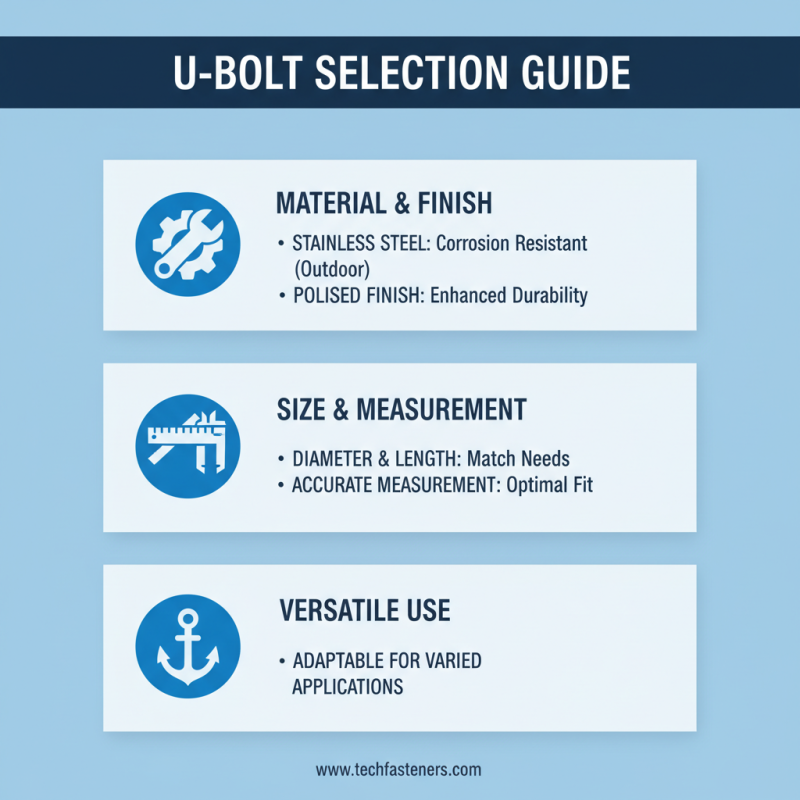
When selecting U bolts for varied applications, several important factors come into play. The material is critical. Stainless steel offers outstanding resistance to corrosion. This makes it ideal for outdoor use. A good finish can enhance durability, so consider polished options. The diameter and length of the U bolts must match your specific needs. Measuring accurately ensures optimal fit and function.
Load capacity is another key consideration. Understanding the weight and stress the bolts will endure helps in making the right choice. Furthermore, the shape and design impact their versatility. Different styles can accommodate various joining methods. It’s important to note that even high-quality U bolts can wear over time. Regular inspections reveal potential weaknesses. This proactive approach improves safety and performance.
Finally, it’s wise to consider the installation process. Some U bolts require specialized tools, while others are more user-friendly. Investing time in selecting the best option can save money down the road. However, the trial and error process may reveal flaws in your initial choice. Reflection on what works best is essential for future projects.